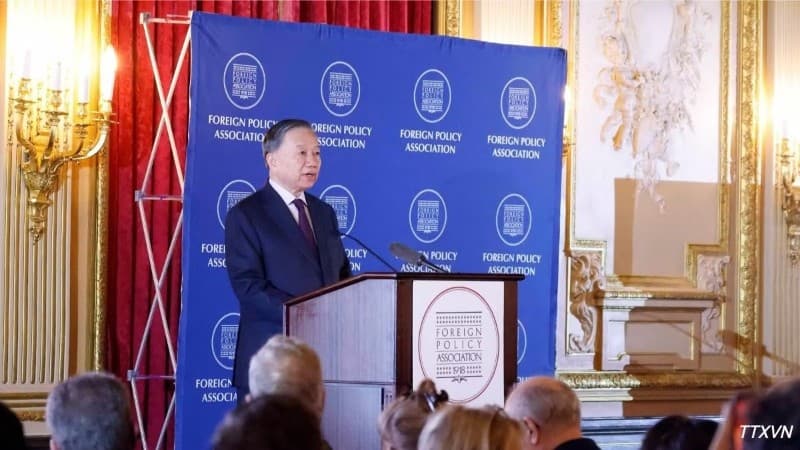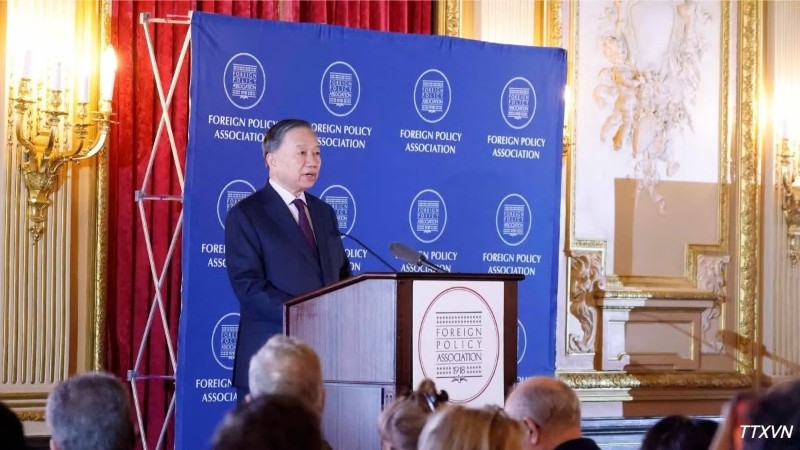
General Secretary and State President To Lam delivered a policy address at the Foreign Policy Association (FPA) in New York on the morning of September 22 (local time), during his working trip to attend the high-level General Debate of the 81st Session of the United Nations General Assembly and conduct bilateral activities in the US.
In his address, Mr. Lam shared Vietnam's perspective on three key issues: responsibility in the face of ongoing global shifts; the journey that brought Vietnam and the US from the past to their present relationship; and the shared responsibility to advance bilateral ties further in the time ahead.
The General Secretary and President emphasized that the world is undergoing epoch-making changes, creating vast opportunities for development alongside considerable uncertainties.
In this context, all nations regardless of size share a collective responsibility for global peace, stability, and human progress. He noted that major powers must make contributions commensurate with their global influence, while small and medium-sized nations should actively take the initiative to help address common challenges.
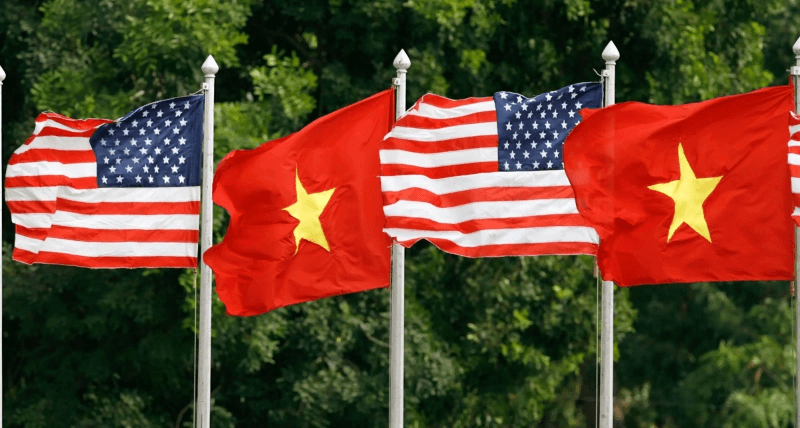
Turning to Vietnam US relations, he affirmed that this sense of responsibility has grown increasingly vital. To achieve today’s Comprehensive Strategic Partnership, both countries had to overcome past losses, deep differences, and a historic deficit of trust.
Looking forward, he underscored that the Vietnam US relationship must make more practical contributions to each nation's goals of development, security, and prosperity, noting that the trust built over decades needs to be continually reinforced with concrete cooperation outcomes.
In that spirit, the Vietnamese leader outlined five major orientations to steer the bilateral partnership forward:
First, both nations need to maintain the relationship’s momentum and build a stable, long-term political foundation commensurate with their Comprehensive Strategic Partnership. On the basis of mutual respect for each other's independence, sovereignty, and political systems, Vietnam stands ready to work with the US to enhance delegation exchanges, high-level and cross-level contacts, improve the effectiveness of dialogue mechanisms, and persistently resolve differences in a satisfactory manner. Defense and security cooperation should continue to develop in line with each side's needs, capabilities, policies, and interests, contributing to regional peace and stability.
Second, the two countries must deepen economic, trade, and investment cooperation to generate new value. Vietnam and the US enjoy complementary markets, resources, and technologies, as well as shared interests in building secure supply chains and bolstering competitiveness. Vietnam values and is ready to discuss US concerns regarding the trade balance, market access, rules of origin, intellectual property, and supply chain security. At the same time, Vietnam hopes both sides will ensure a stable, predictable trade environment that facilitates each other’s goods, services, and investments.
Third, science, technology, and innovation should become a new driver for bilateral ties. Vietnam seeks to prioritize cooperation in training semiconductor engineers and AI experts; connecting universities, research institutes, and enterprises to bring research findings into commercial production; and enhancing capacity so Vietnamese businesses can integrate more deeply into technology supply chains. Vietnam will continue to refine its institutions, protect the legitimate rights and interests of investors, enhance the effective enforcement of intellectual property rights, data safety, and cybersecurity, while ensuring consistency in policy implementation and resolving difficulties for businesses in a timely manner.
Fourth, General Secretary and President Lam emphasized the need to continue promoting the unique values of the Vietnam US relationship through healing and reconciliation, creating a sustainable social foundation. Vietnam will continue its active and effective cooperation in accounting for US personnel missing in action (MIA). Meanwhile, Vietnam hopes the US will continue to partner in dioxin remediation, unexploded ordnance clearance, disability assistance, the sharing of wartime archives and records, and the provision of DNA identification support to help search for, gather, and identify the remains of fallen Vietnamese soldiers. Alongside war legacy remediation, both countries should expand cooperation in education, student and faculty exchanges, cultural exchanges, and sub-national cooperation to create more opportunities for the younger generations of both nations to foster mutual understanding and close bonds.
Fifth, the two sides should elevate regional and global coordination to contribute jointly to peace, cooperation, and development. Vietnam views the US as a Pacific power and supports an active, constructive, and responsible US role in contributing to regional peace, stability, and development, while supporting ASEAN centrality. The two nations still have ample room for cooperation spanning peacekeeping, conflict prevention, health security, energy, supply chains, emerging technology governance, water security, and sustainable development in the Mekong sub-region.
General Secretary and President Lam affirmed that both countries must continue contributing to the maintenance of peace, stability, security, safety, freedom of navigation and overflight, and the rule of law; and to resolving disputes and differences through peaceful means based on the UN Charter and international law, including the 1982 United Nations Convention on the Law of the Sea (UNCLOS).
Source: VnEconomy